
EE Validation TPS62160 DC/DC Buck Converter (Part I)
1 Introduction
Validating electronic devices is a key step in ensuring their reliability and compliance with technical requirements. It confirms that a device functions as intended and maintains stability, accuracy, and efficiency under real-world operating conditions. The validation process involves testing the device under various scenarios to verify that its performance stays within acceptable limits over time.
1.1 Importance of EE Validation of a DC-DC Buck Converter
For power supplies, especially DC-DC converters, validation is essential to verify both load and line regulation. Load regulation measures the ability of the converter to maintain a stable output voltage when the load changes, while line regulation reflects its capacity to keep the output voltage steady despite variations in input voltage. These factors are essential to ensure that connected circuits are supplied with the correct voltage, preventing instability or damage to components.
Testing these aspects also helps identify and address potential design or manufacturing issues, improving overall reliability and extending the device’s lifespan. The validation process typically also covers efficiency, output ripple, transient response, thermal performance, including EMC and load transient measurements, which gives a thorough view of the converter’s performance across all intended operating conditions.
This document uses the TPS6216x DC-DC buck converter series as an example to illustrate the validation procedure and show how these performance parameters are evaluated in practice.
1.2 TPS6216x
Datasheet: TPS6216x 3-V to 17-V, 1-A Step-Down Converters with DCS-Control™ datasheet (Rev. E)
The TPS6216x family are synchronous step-down DC/DC converters designed for high power density applications, featuring a 2.25 MHz switching frequency that enables small inductors, fast transient response, and high output accuracy. With a wide 3 V to 17 V input range, they are suitable for Li-Ion batteries and 12 V rails, providing up to 1 A continuous output current and output voltage from 0.9 V to 6 V.
1.3. TPS62160
The TPS62160 offers an adjustable output voltage, while the TPS62161, TPS62162, and TPS62163 are preset to fixed voltages. In fixed-output versions, the FB pin is internally pulled down and may be left floating, though connecting it to AGND is recommended to improve thermal performance. The adjustable TPS62160 supports output voltages from 0.9 V to 6 V using an external resistor divider from VOUT to AGND, with the FB pin regulated at 800 mV.
2 Equipment
2.1 Used Equipment
- DC Power Supply (GW INSTEK GPD-3303D)
- Thermal camera (Qianli Super Cam X)
- DC Electronic Load (GW INSTEK PEL-504-80-70)
- Precision Energy Analyzer (JOULESCOPE JS220)
- Digital Storage Oscilloscope (SIGLENT SDS 2304X)
- Multimeters (BRYMEN BM257s, BRYMEN BM867s and FLUKE 115)
-
The measurement setup used for testing is shown in Figure 1. It includes all instruments necessary for characterizing the DC/DC converter, observing thermal behavior, and verifying efficiency under various operating conditions. The setup is arranged to enable precise monitoring of voltage, current, temperature, and signal waveforms during operation.
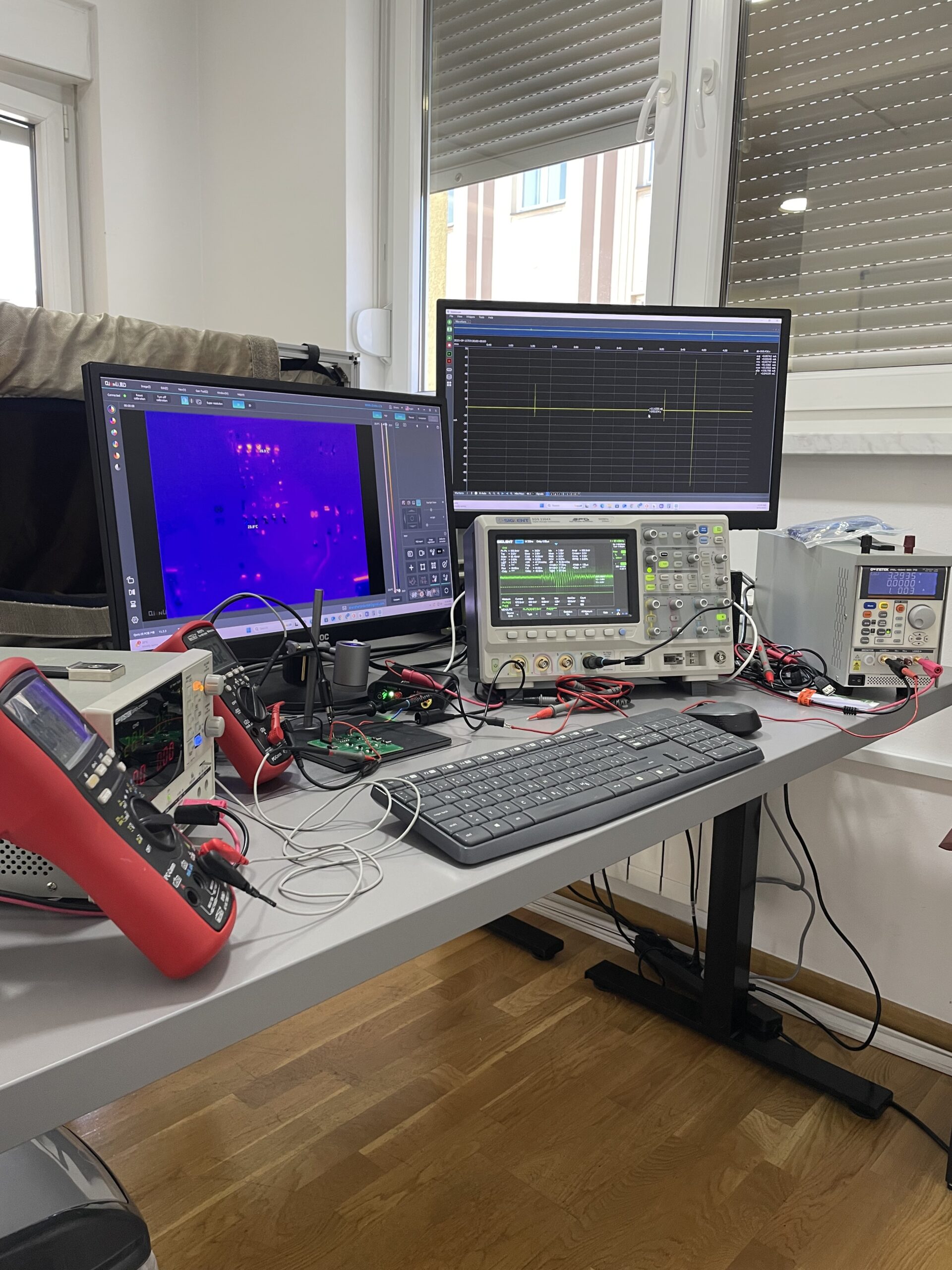
Figure 1 – Setup
A GW Instek GPD-3303D DC power supply provided a stable and adjustable input voltage to the circuit, while a GW Instek PEL-504-80-70 DC electronic load enabled controlled loading of the converter.
Ripple current was measured using a Joulescope JS220 precision energy analyzer, which was also used to capture transients under both rapid load changes and startup conditions, allowing detailed analysis of the converter’s dynamic response. Ripple voltage was observed using a Siglent SDS 2304X digital storage oscilloscope, and DC voltages and currents were measured with digital multimeters (Brymen BM257s, Brymen BM867s, and Fluke) to ensure accurate and reliable readings.
Temperature distribution across the board was monitored using a Qianli Super Cam X thermal camera, enabling detection of potential hot spots and evaluation of heat dissipation.
3 Measurement and Test Overview
This section presents the tests and measurements performed on the TPS62160 DC/DC buck converter. Figure 2 shows the circuit schematic, Figure 3 presents the PCB layout drawn in KiCad based on datasheet specifications, and Figures 4 and 5 provide 3D views of the PCB from the front and back sides, respectively.
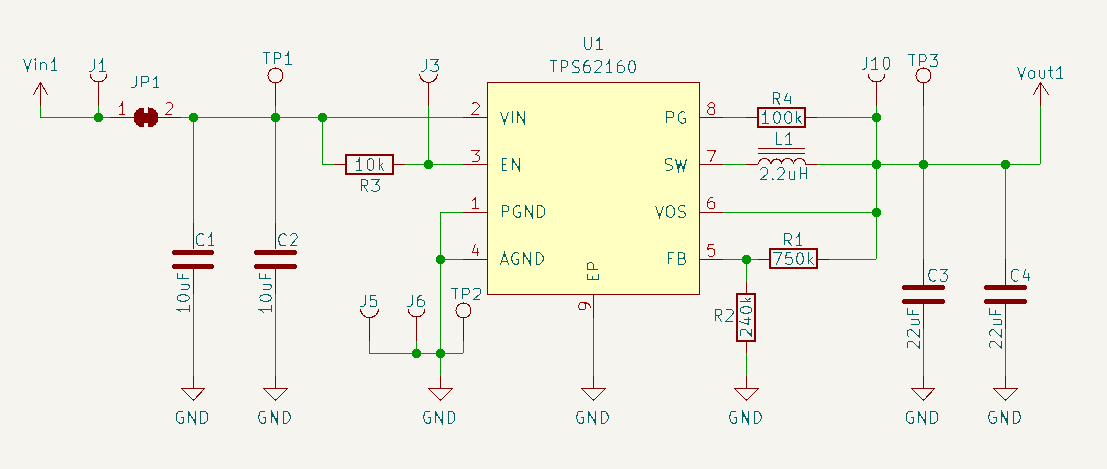
Figure 2 – TPS62160 DC-DC buck converter circuit
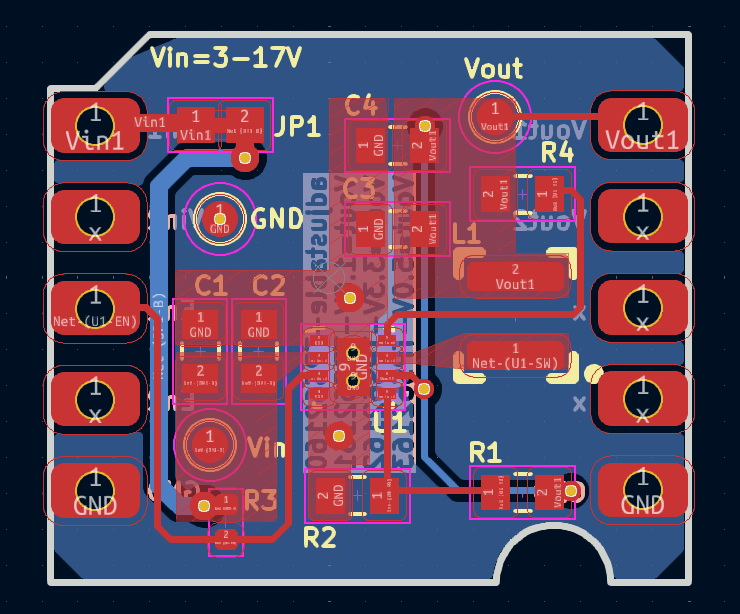
Figure 3 – PCB Layout of the TPS62160 DC-DC Buck Converter Stamp Design
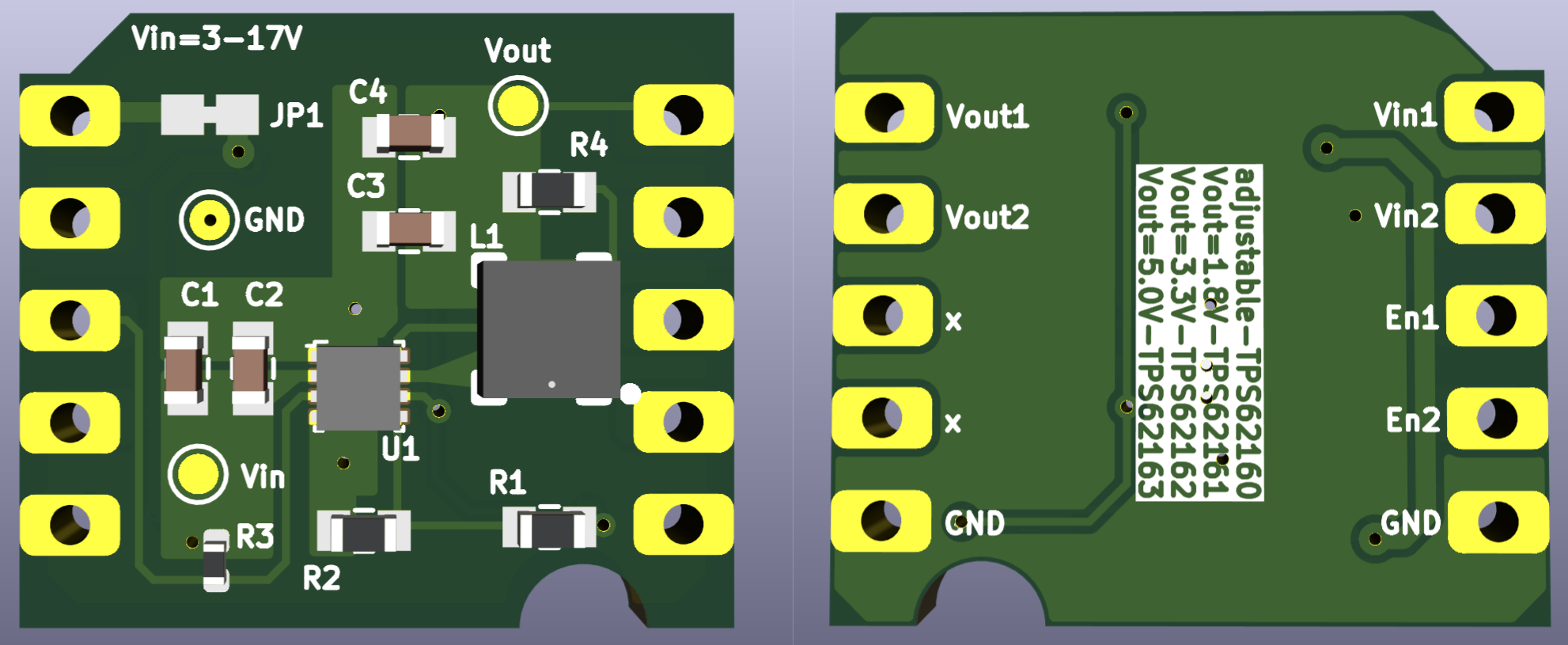
Figure 4 – 3D View of the PCB – Front and Back Side
3.1 Output Ripple Voltage and Ripple Current
Ripple voltage is a small, periodic fluctuation in DC voltage, while ripple current refers to the corresponding changes in current. Excessive ripple can stress electronic components, cause unstable operation, generate extra heat, and ultimately reduce the reliability and lifespan of a device. When ripple voltage and current remain within the recommended limits, the device operates stably, ensuring reliable performance and minimal stress on components.
The first step included measurements of output ripple voltage and ripple current. These measurements were performed first to determine whether the results fell within acceptable limits, allowing any necessary design adjustments to be made before proceeding with further measurements. The ripple voltage was observed using an oscilloscope, while the output ripple current was measured with a Joulescope. Ripple voltage and ripple current measurements were conducted separately to minimize additional measurement errors.
Table 1 shows the measured ripple current values depending on the load and input voltage.
Table 1 – Ripple Currents (mA)
| Load | Input Voltage | ||
| 5 (V) | 12 (V) | 17 (V) | |
| 0 (A) | 0.069 (mA) | 0.119 (mA) | 0.122 (mA) |
| 0.1 (A) | 6.275 (mA) | 1.609 (mA) | 1.370 (mA) |
| 0.5 (A) | 6.887 (mA) | 7.472 (mA) | 6.542 (mA) |
| 1 (A) | 7.490 (mA) | 6.700 (mA) | 6.740 (mA) |
Based on the measured results (see Table 1), the output current ripple remained within 20–40% of the load current, in accordance with the recommended range from Texas Instruments [https://www.ti.com/lit/an/slva477b/slva477b.pdf].
Although the TPS62160 datasheet does not specify exact limits for output current ripple, the output voltage ripple can be referenced from Figure 22 of the datasheet. Figure 6 shows a diagram of the measured output voltage ripple in relation to input voltage and output current. This allows for direct comparison with the datasheet specifications, highlighting how ripple varies under different operating conditions.
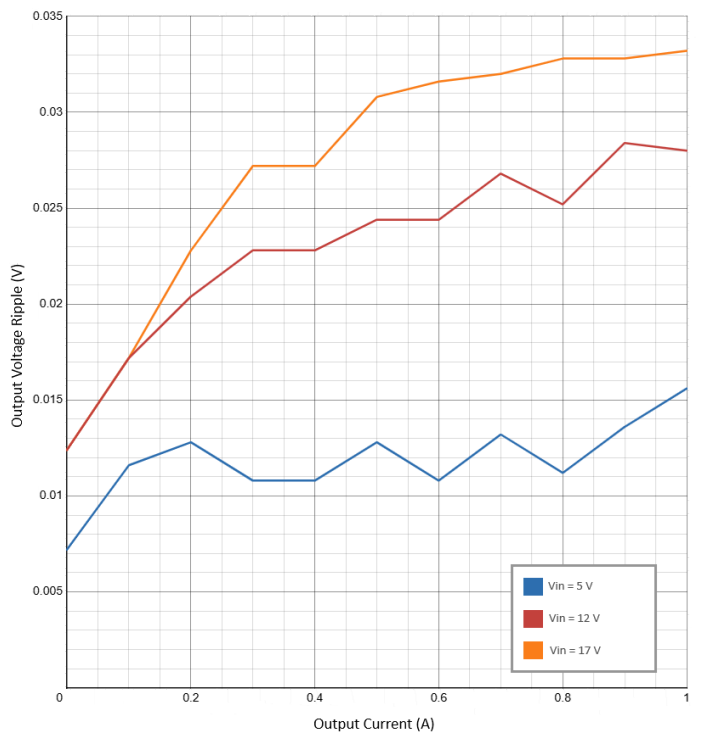
Figure 5 – Output Voltage Ripple
By comparing our measured ripple values with the datasheet diagram, minor differences were observed, but all results remain within acceptable limits. In general, ripple voltage should remain within 1–2% of the output voltage, as highlighted in other TI datasheets [https://www.ti.com/lit/ds/symlink/lm2596.pdf], confirming that both voltage and current ripple in our measurements are compliant.
3.2 Load and Line Regulation
Load regulation is the ability of a power supply to maintain a stable output voltage despite changes in the load. Line regulation is the ability to keep the output voltage steady despite variations in the input voltage. Both are important to ensure stable operation and reliable performance of electronic devices.
Load regulation was tested by maintaining a constant input voltage while varying the load current from 0.02 A up to 1 A in increments of 0.02 A. The corresponding results are presented in the following figures for input voltages of 5 V, 12 V, and 17 V. Comparison with the datasheet (Figure 18) shows a similar trend, with voltage drops occurring at approximately the same operating points (see Figure 7). At higher loads (<1 A), our measurements show slightly larger voltage drops compared to the datasheet curve. However, all results remain within the specified output voltage tolerance of ±1%. For a nominal output of 3.3 V, this corresponds to a tolerance range of 3.267 V to 3.333 V (±33 mV), which confirms that the measured output voltage is fully compliant.
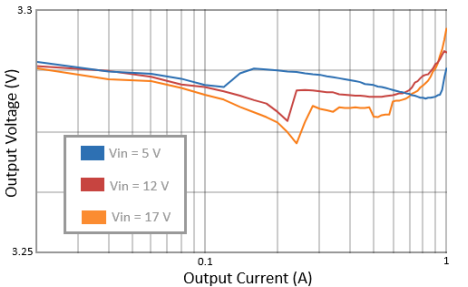
Figure 6 – Load Regulation
Line regulation was performed by keeping the load constant (0.1 A, 0.5 A, and 1 A) while sweeping the input voltage from 5 V to 15 V in 1 V increments. The results, presented in the following figures, are comparable to the datasheet values. Although a slightly larger voltage drop was observed in our measurements, the output voltage remains within the specified tolerance limits, confirming normal operation.
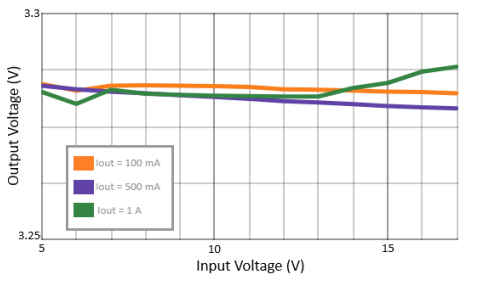
Figure 7 – Line Regulation
3.3 Efficiency
Table 2 – Efficiency (%) of the TPS62160 derived from the datasheet graphs
|
Load |
Input Voltage | ||
| 5 (V) | 12 (V) | 17 (V) | |
| 0.1 (A) | 92.2 (%) | 82.8 (%) | 78.5 (%) |
| 0.5 (A) | 93.7 (%) | 87.3 (%) | 83 (%) |
| 1 (A) | 90 (%) | 85.8 (%) | 83.1 (%) |
In the TPS62160 datasheet, Figures 12 and 13 show efficiency curves for the regulator. To avoid measuring every point presented in the datasheet, we evaluated the most commonly used load currents to see how the input parameters respond to changes in load current at 0.1, 0.5, and 1 A for three input voltage levels: 5 V, 12 V, and 17 V. The resulting measurements have been compiled and are summarized in Table 2.
Table 3 – Measured efficiency of the TPS62160 (Vin = 5 V)
| Load(A) | Vin (V) | Iin (A) | Pin (W) | Vout (V) | Iout (A) | Pout (W) | η (%) |
| 0.1 | 5.060 | 0.07 | 0.3542 | 3.286 | 0.1 | 0.3284 | 92.72 |
| 0.5 | 5.031 | 0.357 | 1.7961 | 3.287 | 0.5 | 1.6435 | 91.5 |
| 1 | 4.98 | 0.77 | 3.8418 | 3.284 | 1 | 3.284 | 85.48 |
Table 4 – Measured efficiency of the TPS62160 (Vin = 12 V)
| Load(A) | Vin (V) | Iin (A) | Pin (W) | Vout (V) | Iout (A) | Pout (W) | η (%) |
| 0.1 | 12.063 | 0.031 | 0.3739 | 3.285 | 0.1 | 0.3285 | 87.56 |
| 0.5 | 12.043 | 0.156 | 1.8787 | 3.283 | 0.5 | 1.6415 | 87.37 |
| 1 | 12.041 | 0.319 | 3.8411 | 3.284 | 1 | 3.284 | 85.5 |
Table 5 – Measured efficiency of the TPS62160 (Vin = 17 V)
| Load(A) | Vin (V) | Iin (A) | Pin (W) | Vout (V) | Iout (A) | Pout (W) | η (%) |
| 0.1 | 16.991 | 0.023 | 0.39082 | 3.285 | 0.1 | 0.3285 | 84.06 |
| 0.5 | 16.984 | 0.115 | 1.9532 | 3.281 | 0.5 | 1.6405 | 83.99 |
| 1 | 16.97 | 0.233 | 3.954 | 3.282 | 1 | 3.282 | 83 |
Input and output parameters were measured, and the corresponding efficiency was calculated. The results of these measurements and calculations are summarized in Table 3, 4 and 5. The values are generally similar to those shown in the datasheet, with only minor differences observed. The lowest efficiency was recorded at the maximum load of 1 A, which is expected given the increased current demand.
3.4 Working Temperature
The operating junction temperature (TJ) range for the TPS62160 is –40 °C to 150 °C. Temperature measurements were performed under three different input voltage levels (5 V, 12 V, and 17 V) while varying the output load current (0.1 A, 0.5 A, and 1 A). Each measurement was taken after the circuit reached thermal stability, approximately 30 minutes after power-up.
The lowest measured temperature was 27.9 °C, and the highest was 66.8 °C, indicating that all temperature values remain well within the specified operating range. Figure 9 shows the lowest recorded temperature (27.9 °C), measured at Vin = 5 V and Iout = 0.1 A, while Figure 10 shows the highest recorded temperature (66.8 °C), measured at Vin = 17 V and Iout = 1 A.

Figure 8 – Minimum and maximum measured temperature
Ambient temperature testing was not performed on this board. However, such measurements will be included and analyzed in future work.
3.5 Transients
In the datasheet, the transient responses are shown in Figures 26 to 31. The scenarios tested include a sudden load change from 100 mA to 500 mA, a sudden load change from 500 mA to 1 A, a startup transient with 100 mA load, and a startup transient with 1 A load at the output. In this document, we focus on the worst-case conditions: the sudden load change from 500 mA to 1 A, and the startup transient with a 1 A load at the output.
According to the datasheet, a sudden load change causes the output voltage to drop by approximately 50 mV, but it quickly returns to its original value. In our measurements, however, the voltage after the transient remains at the reduced level. The only notable difference is that in our case, the voltage drops by about 10 mV regardless of the input voltage. Specifically, our tests show that during a load transient from 500 mA to 1 A, the output voltage decreases by around 10 mV and only recovers when the load is reduced again, however, in the datasheet, the voltage drop occurs over a very short duration, but the magnitude of the drop is much larger, around 50 mV.

Figure 9 – Load Transient Response (500 mA to 1 A)
The next tested scenario is the startup with a 1 A load at the output. In the datasheet, a small current overshoot above 1 A can be observed during startup, which quickly settles to 1 A. The output voltage rises gradually and reaches its final value once the current stabilizes at 1 A.

Figure 10 – Startup Transient Response with 1 A Load
During startup with a 1 A load at the output, a voltage peak of nearly 15 V was observed in our measurements. The datasheet, however, shows no such overshoot under the same conditions. This abnormal spike is likely related to the chip’s soft-start behavior, but a design issue cannot be ruled out and warrants further investigation. Another possible factor could be the laboratory power supply, which might have introduced a transient. Additional investigation is required to identify the exact cause of the spike, and a more detailed analysis will be carried out in future work.
4 Conclusion
Measurements and analysis confirmed that the designed DC-DC buck converter based on the TPS62160 regulator performs within acceptable limits. All key parameters (including output voltage regulation, efficiency, ripple behavior, and thermal response) remained within expected ranges. Minor deviations were observed during testing, but they do not significantly affect overall performance. The converter showed stable and reliable operation across different load and input voltage conditions.
As said, all key parameters met the specified limits, except for the startup transient. The anomaly warrants a more detailed analysis, which will be presented in a future post. This outcome highlights the purpose of the validation process: to uncover potential issues in the design, manufacturing, or within components or power supply, allowing them to be investigated and addressed in future work.

Emina Imširović
Junior Electronic Engineer
A Junior Electronic Engineer with hands-on experience in the complete hardware development lifecycle, from schematic and PCB design to circuit testing and assembly. She is experienced at antenna adjustments and independently researching and implementing practical electronic solutions to meet project needs

S